Home Equity Investments vs. HELOCs: Debt-Free Cash Access Risks
This guide compares Home Equity Investments (HEIs) directly against Home Equity Lines of Credit (HELOCs) to help you decide which liquidity option protects your wealth. If you are looking for a simple, low-cost way to borrow $10,000 for a minor repair, neither of these is likely the right fit. This analysis is for homeowners needing substantial capital who are weighing the safety of a monthly bill against the unpredictability of sharing their home’s future appreciation.
The Core Decision: Debt vs. Partnership
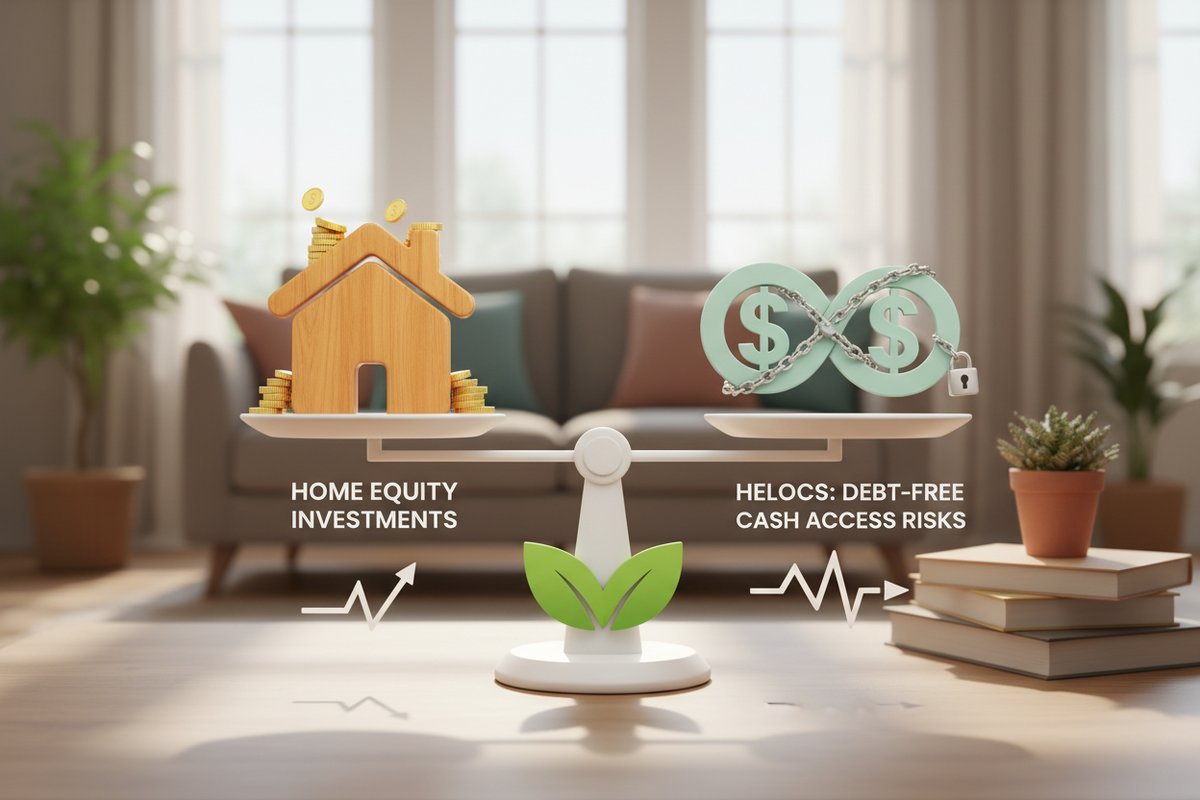
The choice between a HELOC and a Home Equity Investment comes down to one fundamental question: Would you rather pay a known interest rate now or give up an unknown amount of profit later?
A HELOC is a revolving line of credit secured by your home. You borrow money, you pay interest on it (currently averaging around 7.25%-8.25% as of February 2026), and you retain 100% of your home’s equity. It is a debt obligation, meaning if you lose your income, you risk foreclosure.
A Home Equity Investment (HEI), offered by companies like Hometap, Point, and Unison, is not a loan. It is an equity sharing agreement. They give you a lump sum of cash today in exchange for a share (often 15-50%) of your home’s future value. There are no monthly payments, but when the term ends (usually in 10 or 30 years) or you sell the house, you must pay back the original investment plus their share of the appreciation.
Common Mistakes to Avoid
Homeowners often rush into these agreements to solve immediate cash flow problems without calculating the long-term cost. Avoid these critical errors:
- Mistake 1: Assuming “No Monthly Payments” Means “Cheaper.”
In a market where home values rise by just 4-5% annually, the effective APR of an HEI can easily exceed 12-15%. You might avoid a $500 monthly bill today only to owe $150,000 in a lump sum later for a $50,000 investment. - Mistake 2: Ignoring the “Lien” Structure.
You aren’t just signing a contract; these companies place a lien on your property. This can complicate future refinancing or prevent you from taking out other loans against your home until the HEI is paid off. - Mistake 3: Overlooking Buyout Restrictions.
Some agreements, like those from Unlock, allow for partial buyouts, but others may require a full payoff at once. If your home value spikes unexpectedly, buying out the investor becomes incredibly expensive just when you want to regain full ownership.
The Trade-offs: A Mathematical Reality Check
To make a smart decision, you must compare the raw numbers. Let’s look at a realistic scenario for a homeowner needing $100,000.
Scenario A: The HELOC Route
You take a $100,000 HELOC at 8% interest. You make interest-only payments of roughly $667 per month. Over 10 years, you pay about $80,000 in interest. You still owe the $100,000 principal, but you own 100% of your home’s growth. Total Cost: Interest paid + Principal.
Scenario B: The HEI Route
You receive $100,000 from an investor for a 20% share of your home’s future value. Your home is currently worth $500,000. In 10 years, your home appreciates to $800,000 (a modest 4.8% annual growth).
When you exit, you owe the investor 20% of the new value ($160,000) plus potentially the original investment amount depending on the specific contract structure (often calculated as a multiplier of the investment). In many standard appreciation shared contracts, you might pay back significantly more than the cost of a HELOC. Total Cost: A massive slice of your equity wealth.
The Trade-off: With an HEI, you sacrifice massive future wealth to save cash flow today. With a HELOC, you sacrifice cash flow today to protect your future wealth.
When This Doesn’t Work
Neither option is a magic bullet. Here is when you should walk away from both:
- Don’t use a HELOC if your income is unstable.
Since HELOC rates are variable (floating with the Prime Rate), a rate hike combined with income loss is a recipe for foreclosure. If you are self-employed with irregular earnings, the monthly payment obligation is a high risk. - Don’t use an HEI if you plan to renovate immediately.
If you use HEI funds to add a new room or remodel a kitchen, you are increasing the home’s value. Since the investor gets a percentage of the final value, you are essentially paying them a commission on your own hard work and investment. - Don’t use either for consumption.
Using home equity to pay for vacations, weddings, or depreciating assets like cars is generally a poor financial decision. You are financing short-term pleasure with a long-term asset.
Your Checklist
Use this checklist to finalize your decision before contacting a lender or investor.
☐ Check your credit score first.
If your score is above 720, a HELOC is likely cheaper. If it’s under 600, HEIs like Splitero or Point may be your only option.
☐ Calculate your “Break-Even” appreciation.
Ask the HEI provider: “If my home value doubles, exactly how much will I owe you?” If the number shocks you, don’t sign.
☐ Verify the term length.
Hometap typically offers 10-year terms, while Unison offers up to 30 years. A shorter term increases the risk that you’ll be forced to sell during a market downturn to pay them back.
☐ Assess your discipline.
With a HELOC, can you commit to paying more than the minimum interest-only payment to pay down the debt? If not, you may carry that debt forever.
☐ Review current rate trends.
Check the latest Prime Rate trends on Bankrate to see if HELOC costs are projected to rise or fall in 2026.
Final Verdict: Which Should You Choose?
The real question is not about which product is easier to get, but which risk you can afford to manage.
Choose a HELOC if: You have a stable income, a good credit score (700+), and you want to keep every dollar of your home’s appreciation. It is the cheapest money available for disciplined borrowers who can handle a monthly bill.
Choose a Home Equity Investment if: You are house-rich but cash-poor, have a lower credit score (under 650), or absolutely cannot afford another monthly payment. It is a valid safety valve for emergencies, provided you accept that it is likely the most expensive money you will ever access in the long run.